Math: Lesson and Analysis
Lesson Summary:
Classroom arrangement and management issues:
I planned my lesson to be taught with all of the students sitting together at a small table in the library.
I developed the lesson knowing that the students were struggling with its underlying concepts. I was also aware (based on previous observations) that two of the students in the group respond to frustration by shutting down. I took this into consideration when structuring the lesson. I sought to provide as many differentiated options as possible in hopes that the students would avoid unnecessary frustration.
Additionally, I planned to teach the lesson on the Monday following Thanksgiving break, shortly after the students had returned from recess.
I had anticipated that these factors, especially in combination, may make it harder for some students to focus, and attempted to prepare for that possibility.
However, when it came time to teach my lesson I faced an additional, unanticipated obstacle. A book fair had been planned for the end of the week during which I scheduled my lesson. Unbeknownst to me, the library was unavailable, as the staff needed time to setup. Fortunately, I was able to find an open classroom in which to teach my lesson, and proceeded as planned.
I began the lesson by briefly reviewing multiplication/division by asking students why/when they would multiply or divide. The students framed their responses in terms of school. I built off of thier contributions to segue into the lesson by noting that math is all around us. I explained that it extends to the world outside of school, framed with words as opposed to mathematical symbols, which is which is why story problems are so important. As my observer noted, this may have been a good opportunity to ask the students to make personal connections to real-world math. I agree with this suggestion. Upon reflection, involving the students in this way may have helped to scaffold the tasks that followed.
Following this introduction, I asked the students to suggest a story problem for the number sentence 6 x 8. I wrote the problem on a sheet of chart paper, then proceeded to ask for solution strategies, which I also recorded (a 6 x 8 array). I repeated this process for division with the number sentence 36/4, which a student modeled solving with 36 unifix cubes arranged in nine stacks of four.
Next, I returned to multiplication to model developing and solving number sentences when presented with a prewritten story problem. Again, I proceeded to division.
At this point, we transitioned from the carpet to desks where the students worked independently to create and solve story problems for the number sentences 8 x 7 and 48/6. I encouraged the students to use manipulatives if they felt that it would be helpful to do so.
We then returned to the rug to discuss the students' story problems as solution strategies as a group. The students were engaged in this discussion and eager to share their thinking with the group.
I concluded the lesson by asking the students to complete an exit ticket with two prewritten story problems.
Further analysis of the lesson as a whole and the students' work in particular can be found below.
The Four Dimensions in Play:
Tasks:
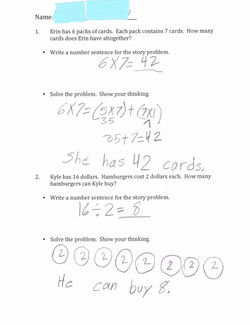
Following a group introduction to the mathematical concepts, the students worked independently on two tasks. First, students wrote two story problems, illustrating their thinking for each through a drawing or the use of manipulatives. For the second task, I provided each student with a sheet with two multiplication/division story problems. I asked the students to analyze these problems, write a number sentence for each, and to illustrate their thinking by drawing a picture or using manipulatives. The later of these tasks also served as an exit ticket.
My goal was to help students develop deeper conceptual understanding of problem structure and the relationships multiplication and division represent, through solving problems. As Hiebert explains, “it is only through solving problems that their concepts and procedures develop together and remain connected in a natural and productive way (25).”
As my observer noted--the students were eager to participate and share their thinking. However, I felt pressed for time throughout the lesson. My observer noted that the pacing was off, and I agree. I am left wondering whether--mathematical appropriateness aside--I planned too many tasks. I must also wonder if this detracted from the students' learning.
Discourse:
Periods of group activity were structured to allow students to lead the discussion. I attempted to act as a facilitator and scribe, and to focus on having students explain their thinking and revoice the thinking of other students to focus on the underlying meaning of multiplication and division relationships. As noted by my observer, the students "were focused and engaged." She also noted that I "continually encouraged [the students] to explain their thinking." However, she also noted that while introducing the lesson I missed an opportunity to ask the students to make personal connections to real-world math. I agree with this suggestion. Upon reflection, involving the students in this way may have helped to engage them in the concept and scaffold the tasks that followed.
Tools:
As planned, I provided each student with sheets of partial number sentences, scratch paper and pencils, and a variety of manipulatives (e.g. unifix cubes, paper bags, and bins) for the first task. For the second task, I will also provided a sheet of story problems. All of these materials are familiar to the students. My intention in including them was to help support the students’ thinking by providing a variety of differentiated options with which to approach the problems. I believed that my choice of manipulatives would be especially helpful in modeling grouping situations.
However, I had planned the lesson to be taught in library, and assumed that my workspace would be configured in a particular way. When I was unable to use the library, I was unable to adapt. Most significantly, although I had planned to use manipulatives extensively, theses were largely forgotten for the first part of the lesson.
As the lesson progressed, I attempted to recover from this oversight. As my observer noted, I began encouraging the students to use the manipulatives if needed. As I had anticipated, the students employed various tools to show their thinking. Some completed their calculations numerically, others drew pictures, and some used the cubes. As I observed this, I was glad that I had provided a variety of options.
Norms:
I was able to review and rely on established class norms throughout the lesson. I structured the lesson to mirror the normal sequence in the classroom. The classroom teacher often begins lessons with a whole group discussion. On these occasions, he often directs the students to work independently before sharing and discussing their work with the group. Additionally, the use of a thumbs up to signal readiness to contribute is an established norm in the classroom. Following reflection, I believe that maintaining these mathematical norms helped to ground the lesson and keep the students focused.
Student Work:
 |
|---|
 |
 |
 |
 |
 |
Moving Forward
Having reflected on my experiences while writing and teaching the lesson, I believe that I designed a much stronger lesson that I taught.
I took care to structure the lesson to help students develop deeper conceptual understanding of problem structure and the relationships multiplication and division represent, through solving problems. I provided a variety of materials--from number sentences and story problems to manipulatives--to facilitate this process.
However, I it was not until I taught and reflected on the lesson that I had also incuded a great deal of rigidity.
I planned the lesson to be taught in library. As such, I assumed that my workspace would be configured in a particular way. When I was unable to use the library, I was unable to adapt. Most significantly, although I had planned to use manipulatives extensively, they were all but forgotten.
I felt like I was playing catch-up throughout the lesson, and rushed through portions on which would like to have spent more time.
While, in retrospect, I could simply have reduced the number of tasks in the lesson, I was unable to adjust in the moment. I lacked the flexibility and adaptability to deviate from my plan.
Moving forward, I intend to avoid repeating this scenario. While I cannot control external events, I am able to prepare for the possibility and to respond appropriately.